




Gilkie Camp Trailers of 1934: Your Vacation Home on Wheels
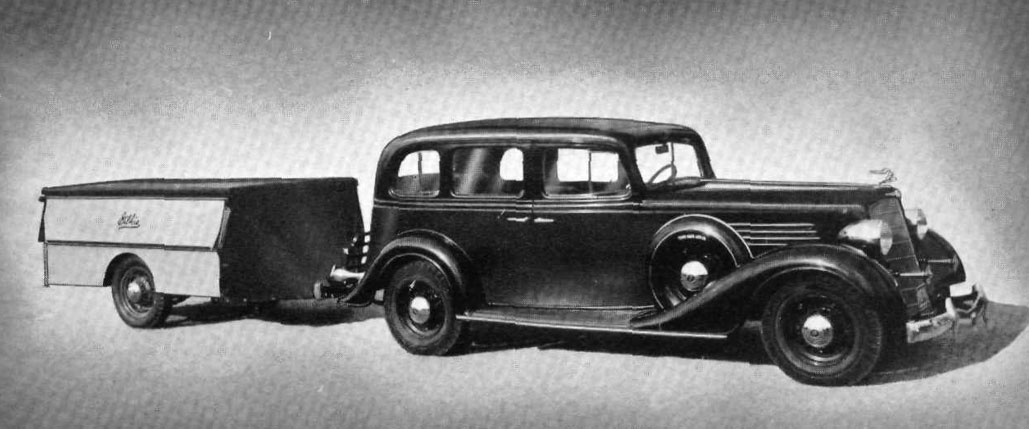
The 1934 Gilkie Camp Trailers catalog captures an early moment in American recreational travel, when the automobile was changing not only how people moved, but how they imagined leisure. Produced by E. P. Gilkison & Sons Company of Terre Haute, Indiana, the catalog sells more than a trailer. It sells the idea that a family could take a small, self-contained vacation home with them wherever the road led. Travel is framed as refreshment, outdoor life as physically and morally beneficial, and economy as a central part of the appeal.
Gilkie itself grew out of an automobile-body and machine-shop business. Active from the mid-1920s into the early 1950s, E. P. Gilkison & Sons helped bridge the gap between tent camping and the later travel trailer, offering compact, towable “vacation homes” for ordinary motorists. The trailers belonged to an in-between moment in design history. They were not sleek postwar aluminum trailers, and they were not yet the fully enclosed travel trailers that became common later. Instead, they were closer to folding cabins on wheels: part tent, part furniture, and part vehicle accessory.
The catalog features two main models, the Gilkie De Luxe and the Gilkie Camp King. Both had the squared, tent-like form typical of early folding camp trailers, with canvas sides, screened windows, built-in beds, and compact interiors. The De Luxe was the more fully equipped model, with a bedroom, living room, and kitchenette arrangement, along with built-in beds that could double as couches, a center table, a kitchen cabinet, storage lockers, electric lights, screened windows, and a stove option. The Camp King was positioned as the more economical model, offering many of the same pleasures at a lower cost.
Gilkie emphasized that its trailers were low, compact, and light enough to be towed behind ordinary cars. A streamlined front end reduced air resistance, and the catalog includes a full page showing Gilkie trailers paired with popular-priced cars such as Plymouth, Terraplane, Dodge, Pontiac, Chevrolet, and Ford. The message was clear: trailer travel was not reserved for luxury motorists. Gilkie wanted buyers to see this as a practical, manageable, middle-class form of recreation. The trailer’s utility was a major part of its appeal. It had to feel simple rather than intimidating, and Gilkie repeatedly stressed that one person could handle it, that the canvas protected the contents from weather, and that the trailer could serve for weekend trips, longer vacations, or even seasonal camp living.
Accessories expanded the trailer into a complete outdoor domestic system. Extension tents, enclosures, flys, camp stoves, folding cabinets, and white enamel camp dishes all appear in the catalog, showing how Gilkie was selling more than a vehicle attachment. It was selling a method of outdoor living. A trailer could become a porch, a dining room, a lakeside camp, or a temporary summer home.
At the same time, the prices make clear that Gilkie was not selling to the average struggling Depression household. In the catalog, the Gilkie De Luxe is listed at $495 and the Camp King at $395, with accessories adding more. In today’s terms, that puts them roughly in the range of $12,000 and $9,800. These were not impulse purchases. Likely buyers were people who still had stable income, a reliable car, leisure time, and enough confidence to spend on travel equipment during the Depression. They were probably professionals, business owners, managers, skilled workers, or otherwise comfortable middle-class families.
That helps explain why the catalog works so hard to frame the trailer as economical rather than extravagant. Gilkie’s sales pitch is that, while expensive up front, the trailer would make future vacations cheaper. The catalog argues that travel costs could be reduced mostly to “food, gasoline and oil,” and that families could avoid hotel bills and expensive resort stays. In that sense, the trailer was marketed almost like a thrift investment: buy the equipment once, then take affordable vacations for years. Buyers also needed to already own a car capable of towing it, which placed them above the most economically distressed households of the period.
What makes the catalog especially appealing today is the way it sits between two eras. It still belongs to the older world of tent camping, canvas, folding furniture, and rugged motor touring, but it points toward the trailer culture that would grow dramatically after World War II. More than anything, the catalog reflects a new way of thinking about vacation. Home no longer had to be fixed in one place. With a car, a trailer, and a stretch of open road, it could unfold wherever you stopped.