



Metlox’s Pepper Tree: A Leafy California Take on Modern Dinnerware
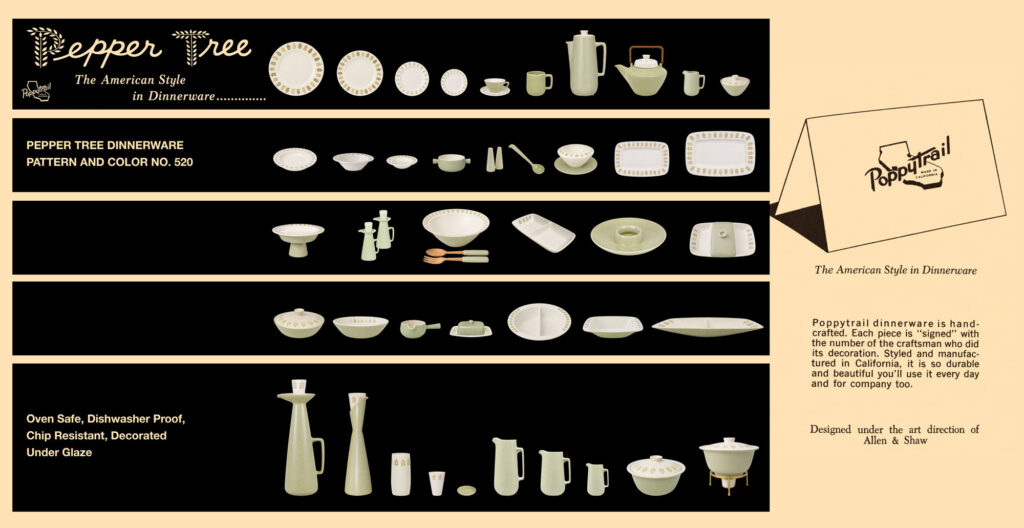
Metlox introduced Pepper Tree in the late 1950s as part of its Poppytrail dinnerware line. The pattern used the same modern shape family associated with Metlox’s Navajo and Tempo lines, giving it the low, clean, contemporary profile that appeared across several of the company’s postwar dinnerware designs.
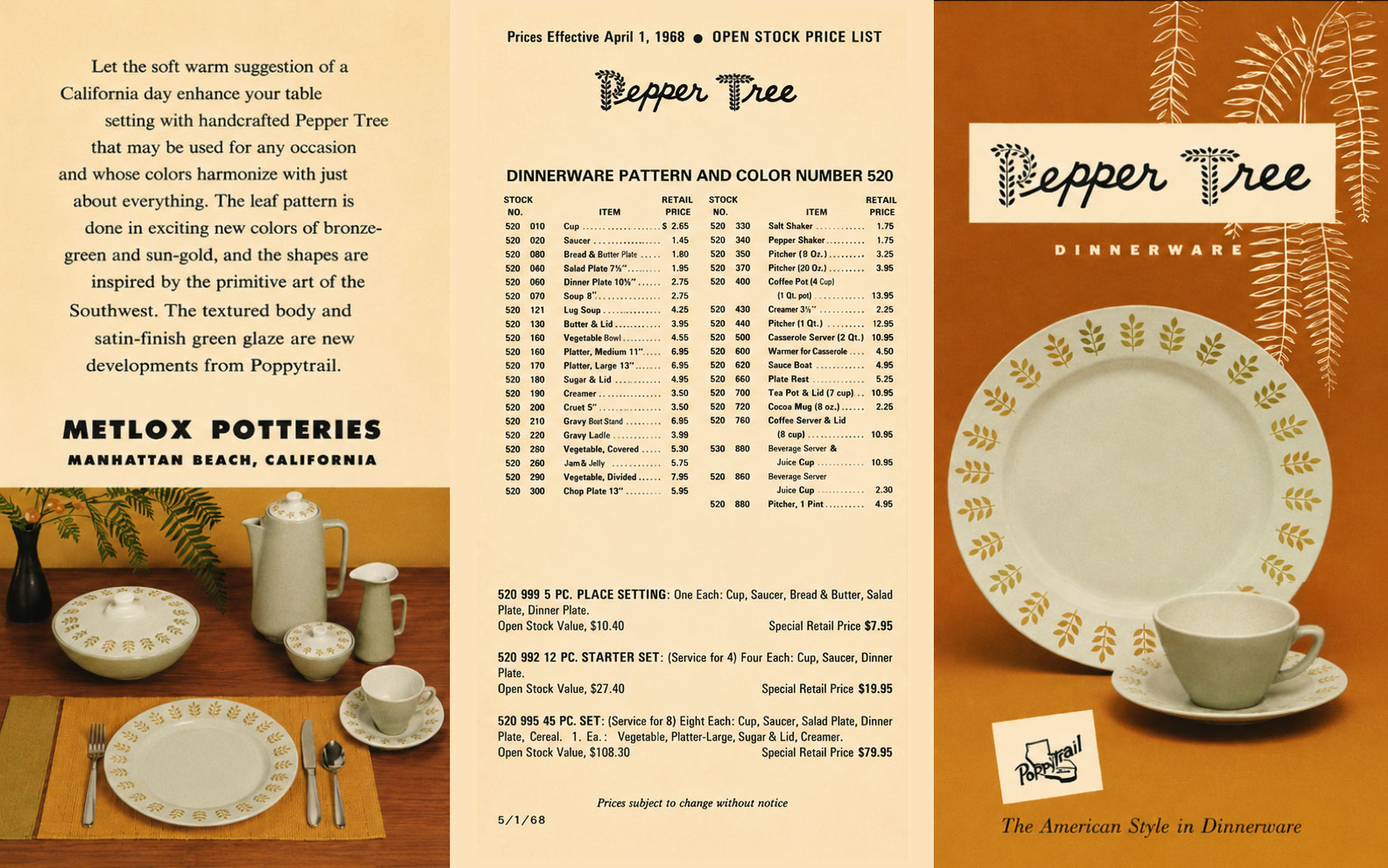
Pepper Tree was pattern and color number 520. The decoration is simple: small repeated leaf forms arranged around plate rims, lids, cups, and serving pieces. The leaves were described in Metlox advertising as bronze-green and sun-gold, set against a satin-finish green glaze. The result is a quiet pattern, more restrained than Navajo and less graphic than Tempo, but still clearly tied to the same California modern moment.
The name also had a particular California resonance. The so-called California pepper tree, often seen in Southern California landscapes, is not native to the state, but by the twentieth century it had become strongly associated with older California settings. Its feathery leaves, drooping branches, and peppercorn clusters appeared around mission grounds, ranch houses, courtyards, roadsides, and residential neighborhoods. For a Manhattan Beach pottery promoting “The American Style in Dinnerware,” the name Pepper Tree suggested warmth, shade, patios, and casual California living.
The original promotional language emphasized that same feeling of warmth and everyday use. Metlox described Pepper Tree as suitable for any occasion, with colors that would “harmonize with just about everything.” The company also promoted the line as handcrafted, durable, oven safe, dishwasher proof, chip resistant, and decorated under glaze.
Although Pepper Tree is generally associated with the late 1950s, it continued to appear in Metlox materials after that period. A 1968 open-stock price list shows a broad assortment of Pepper Tree pieces still available, including cups, saucers, bread and butter plates, salad plates, dinner plates, soups, cereal bowls, platters, covered vegetables, divided vegetables, casseroles, pitchers, coffee and tea pieces, salt and pepper shakers, gravy pieces, and beverage servers. The line was also sold in boxed place-setting and starter-set groupings.
One of the interesting features of Pepper Tree is how differently the shared shape reads when compared with Navajo and Tempo. The basic forms are familiar, but the surface treatment changes the effect. Pepper Tree feels softer and more domestic, with a muted sage-green body, ivory interiors, and small leaf accents rather than bold geometric decoration.
Metlox’s advertising connected the pattern to California living and to a generalized Southwest influence, language that was common in mid-century dinnerware promotion. In practice, Pepper Tree is less themed than many patterns of the period. Its appeal comes from the combination of simple modern forms, muted glaze, and restrained decoration.