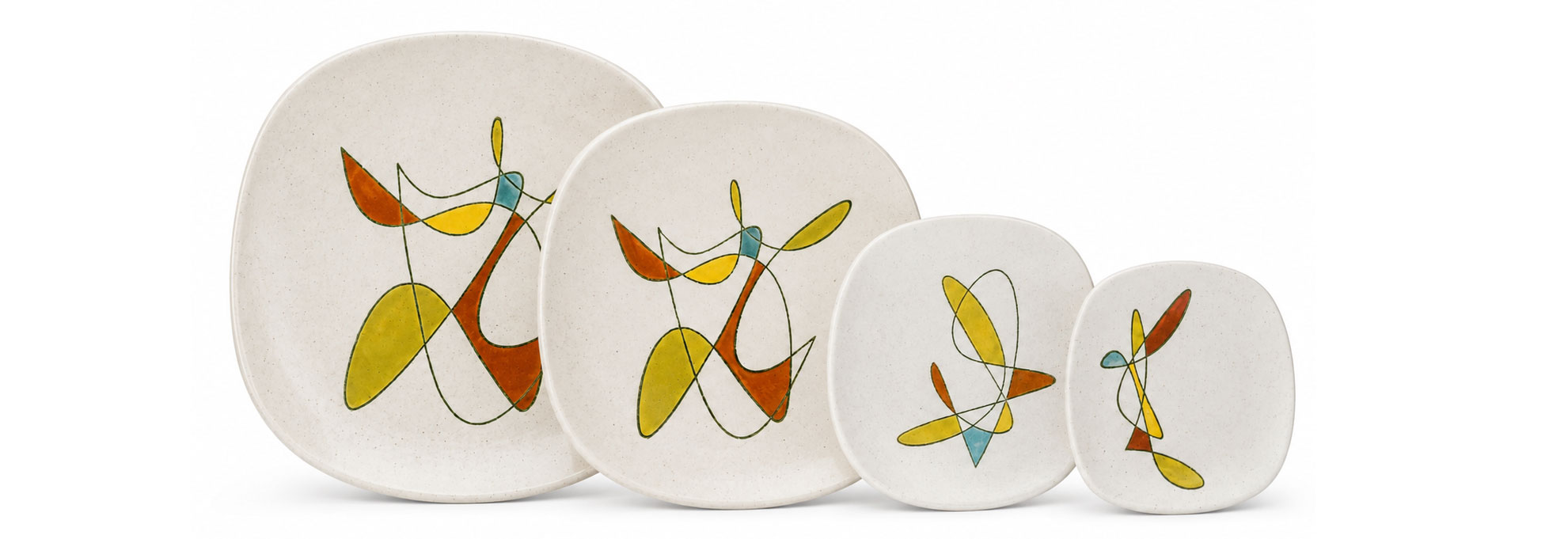




Metlox California Freeform: Modern Dinnerware for People Who Wanted Something Different
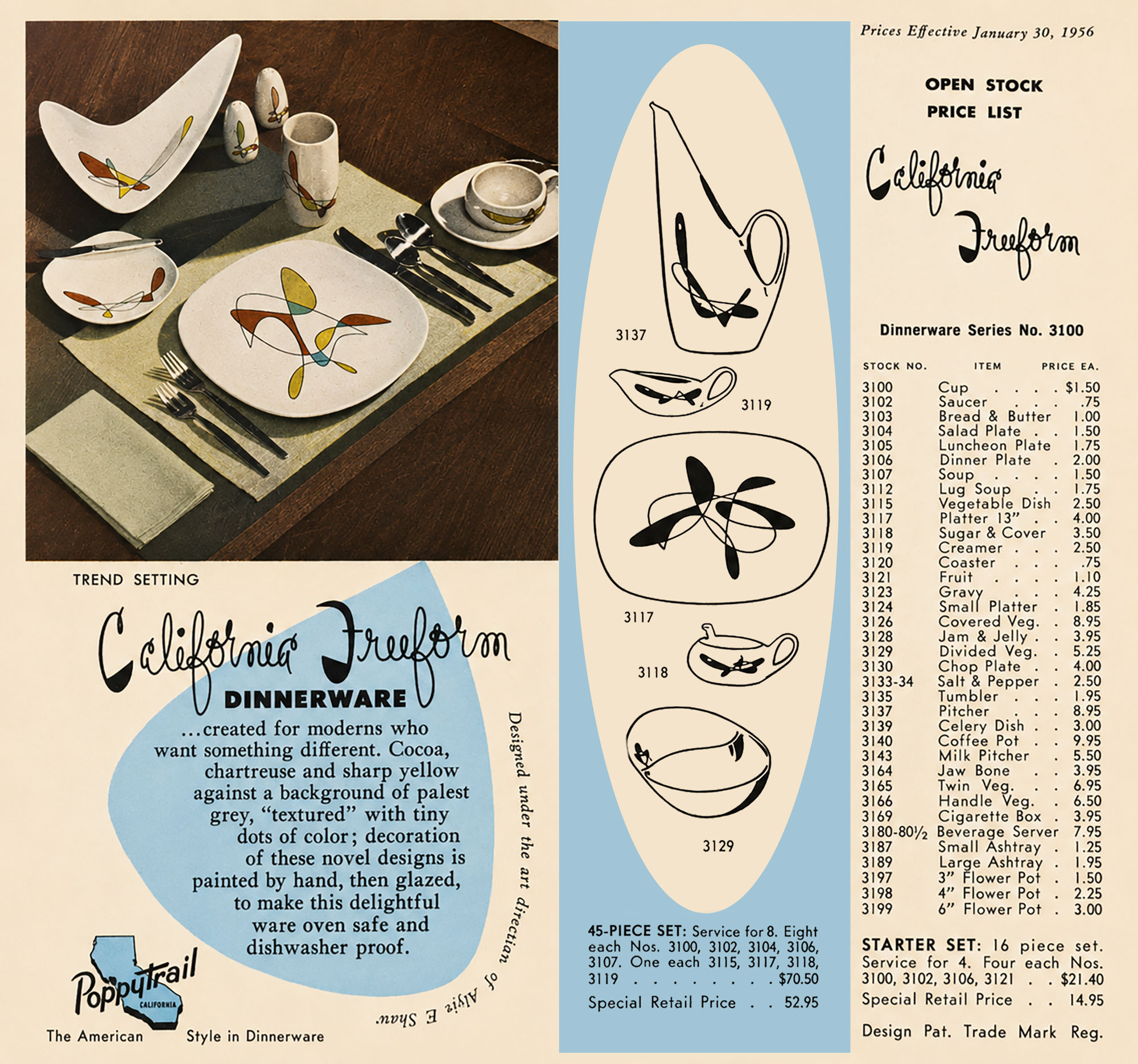
Metlox introduced California Freeform in the mid-1950s as part of its Poppytrail dinnerware line, and the name was not just marketing. The shapes were loose, sculptural, and asymmetric, with squared plates, pulled handles, sloping pitchers, and serving pieces that looked more like small modernist objects than conventional tableware. The line was aimed directly at a postwar consumer who wanted something casual, practical, and visibly modern.
The Freeform shape is credited to Frank Irwin, a Los Angeles-area designer whose work for Metlox gave the company one of its most adventurous mid-century forms. Introduced around 1954, Irwin’s Freeform blanks moved away from traditional round symmetry in favor of irregular silhouettes, squared plates, boomerang-like serving dishes, and expressive handles. His contribution was the underlying form rather than necessarily every surface decoration applied to it. That distinction is useful because the same Freeform shape was used across several Metlox patterns, including Mobile, Shoreline, Contempora, and Aztec, with each pattern giving the shared shape a different personality.
California Freeform paired Irwin’s modern blanks with a distinctly atomic hand-painted design. The brochure describes the palette as cocoa, chartreuse, and sharp yellow against a pale grey textured ground, accented with tiny dots of color. The decoration was painted by hand and then glazed, making the ware oven safe and dishwasher proof. It was not studio pottery, but it borrowed some of the visual language of studio pottery and translated it into open-stock dinnerware for everyday use. The design itself is shared with the California Mobile and Contempora lines.
The brochure’s language shows exactly how Metlox wanted the line to be understood: “trend setting,” and “created for moderns who want something different.” That positioning places Freeform squarely within the larger story of 1950s California ceramics, when companies like Metlox were selling dinnerware that felt regional, informal, artistic, and distinctly American.
Freeform also crossed over with Metlox’s broader hostessware strategy. Some serving and specialty pieces were shared with the Tropicana/Mosaic line, showing how the company reused successful modern forms across related patterns and categories. This gave buyers a wider range of coordinated table and serving pieces while allowing Metlox to extend its most successful shapes into different decorative treatments.