



“Furniture of Romance”
Ficks Reed occupies a distinctive place in American furniture history: not quite mainstream modernism, not simply patio furniture, and not merely decorative wicker. At its best, the company helped translate rattan, reed, bamboo, cane, and woven materials into furniture that felt architectural, cosmopolitan, and relaxed. For much of the twentieth century, Ficks Reed sat at the intersection of resort style, Hollywood Regency, mid-century modernism, and the American fascination with tropical and Asian-inspired interiors.
The company traces its origins to 1885, when Louis Ficks founded what was initially known as the National Carriage and Reed Company. Early production centered on woven reed and wicker baby carriages, a logical beginning at a time when wicker was valued for being lightweight, durable, breathable, and relatively easy to shape. Sources differ slightly on whether the earliest company identity should be described as New York-based or Cincinnati-based, but by the turn of the twentieth century Ficks Reed was firmly associated with Cincinnati, Ohio, which became its long-term manufacturing and business home. From that base, the company expanded from baby carriages into furniture made from wicker, rattan, bamboo, woven peel, cane, and selected hardwoods.
That transition from carriage maker to furniture manufacturer was more than a change in product line. It placed Ficks Reed within a broader American design story. Wicker and reed furniture had long been associated with porches, summer houses, conservatories, and informal domestic spaces, but in the early twentieth century these materials began to move into more varied interiors. They suggested leisure, travel, ventilation, lightness, and informality. As American homes modernized, and as resort culture became a major influence on taste, woven furniture offered a way to make interiors feel less formal without abandoning craftsmanship.
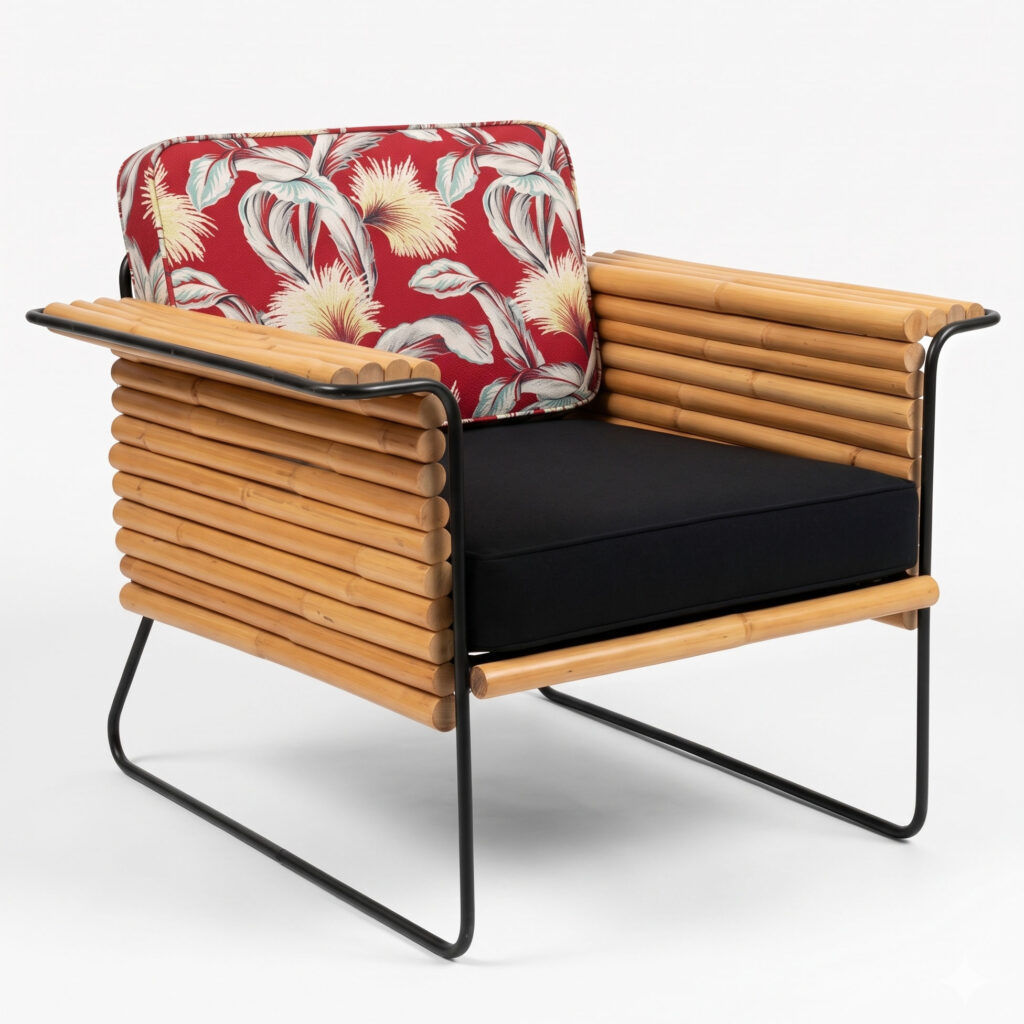
Ficks Reed’s importance grew because the company treated these materials seriously. Rattan and bamboo were not used only as rustic or novelty materials; they were shaped into structured lounge chairs, sofas, tables, dining pieces, chests, and full room groupings. The best pieces have a strong sense of line. Frames are often carefully wrapped, joints are emphasized rather than hidden, and the tension between hard structure and flexible material gives the furniture much of its visual appeal. This is one reason Ficks Reed pieces still read well today: they have enough decorative texture to feel warm, but enough discipline in the form to avoid looking fussy.
By the middle decades of the twentieth century, Ficks Reed was working with a notable group of designers and decorators. The company is associated with figures including Dorothy Draper, Paul T. Frankl, Paul László, John B. Wisner, and Pipsan Saarinen Swanson. These collaborations helped move Ficks Reed beyond ordinary wicker furniture and into the world of designed interiors. Draper’s connection is especially important because she was one of the most visible American decorators of the period, known for her dramatic, high-contrast, oversized, modern-baroque approach. Dorothy Draper & Company notes that Draper was involved in early designer collaborations that included furniture for Ficks Reed, while later accounts also connect Ficks Reed furniture to luxury properties shaped by Draper’s influence, including The Greenbrier.
John B. Wisner’s work for Ficks Reed is among the company’s most admired mid-century output. His “Far Horizons” collection, introduced in 1954, incorporated Eastern-inspired elements into rattan and cane furniture with a sophisticated, almost campaign-style sensibility. Auction and design-market records consistently identify Far Horizons pieces as 1950s Ficks Reed designs using rattan, cane-wrapped joints, brass accents, and low, lounge-oriented forms. These pieces show how Ficks Reed could absorb international and historical references without becoming literal pastiche. The result was furniture that felt worldly, relaxed, and modern at the same time.
Ficks Reed also benefited from larger shifts in American taste. In the 1940s, 1950s, and 1960s, rattan and bamboo furniture became closely associated with sunrooms, Florida rooms, patios, resorts, and the tropical modern look. American consumers were increasingly drawn to interiors that suggested travel, informality, and indoor-outdoor living. This was the same cultural atmosphere that supported tiki rooms, resort hotels, Hawaiian shirts, bamboo bars, and the domestic fantasy of the permanent vacation. Ficks Reed’s furniture was often more refined than the most theatrical versions of that trend, but it belonged to the same world of leisure, climate, and escape.
The company’s hospitality work reinforced that association. Ficks Reed furnished hotels, resorts, clubs, and restaurants for decades, with sources linking the company to properties such as The Greenbrier, The Breakers Palm Beach, the Arizona Biltmore, Ritz-Carlton hotels, Four Seasons hotels, Marriott, Hyatt Regency, and others. This commercial presence mattered because it placed Ficks Reed furniture in aspirational settings. A chair or sofa was not just a domestic object; it carried the memory of lobbies, terraces, verandas, poolside lounges, and resort interiors.
What makes Ficks Reed especially interesting today is that the company’s work does not fit neatly into one category. Some pieces are Hollywood Regency, especially those connected to Draper’s world of high-style decorating. Some are mid-century modern, with clean lines, modular forms, and low seating. Some are campaign-inspired, with brass details and dark finishes. Others belong more naturally to sunroom, porch, or coastal interiors. That range is part of the appeal. Ficks Reed was not a single-look company; it was a materials-driven manufacturer that adapted rattan, wicker, bamboo, and cane to changing ideas of American comfort.
The later history of the company reflects many of the pressures that affected American furniture manufacturing more broadly. As production costs, import competition, changing retail patterns, and shifting consumer tastes reshaped the industry, companies built on handwork and specialized materials faced increasing challenges. Ficks Reed continued into the twenty-first century, but in 2011 Furniture Today reported that the company appeared to have closed, noting that its Cincinnati office and distribution center were closed and that the business had previously been acquired out of bankruptcy in 1996.
Today, Ficks Reed survives most visibly through the vintage market. Original pieces are collected, restored, lacquered, re-caned, reupholstered, and reintroduced into interiors that once again value texture, natural materials, and relaxed modernity. The renewed interest in rattan and wicker has helped bring the company back into design conversations, but Ficks Reed’s appeal is not simply nostalgia. Its best furniture still works because it balances opposing qualities: casual and elegant, decorative and restrained, lightweight and substantial, tropical and urban, traditional in material but modern in attitude.