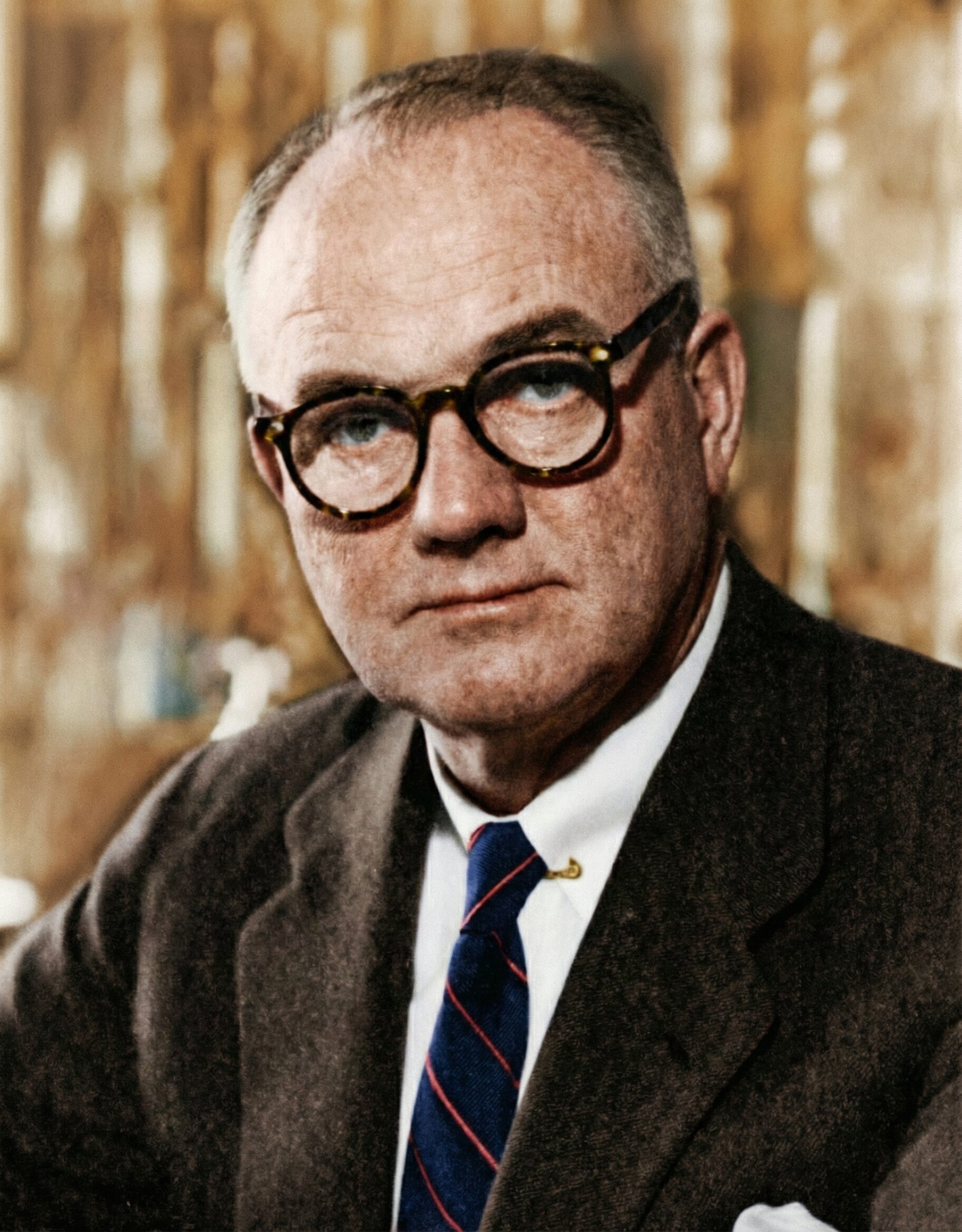





Heywood Designer: Leo Jarenik
When Heywood-Wakefield set out to reinvent itself in the early 1930s, it did so at a moment when American taste was shifting decisively toward the clean, optimistic lines of the Machine Age. Colonial revival forms still dominated mainstream furniture, but a younger generation of designers, engineers, and artists were beginning to imagine domestic interiors shaped by speed, motion, and modernity. Streamlined forms, machine-age materials, and simplified silhouettes celebrated at events like the 1933–34 Chicago World’s Fair reshaped public expectations of what “modern living” should look like.
For Heywood-Wakefield, this cultural shift aligned with a deeper internal need to diversify beyond its historic strengths in wicker, institutional furniture, and cottage styles. These categories remained reliable but could not carry the brand into a design-forward future. The company had also begun investing in advanced machinery capable of bending solid wood and producing smooth, uninterrupted curves—technological capabilities that enabled a new streamlined new design language.
Leo Jiranek, an influential American furniture designer and a pivotal figure in Heywood-Wakefield’s transition into modern design. Born in Grand Rapids, Michigan, Jiranek trained as an engineer at Princeton University before turning to design, bringing a combination of technical precision and artistic instinct to the field.
Over a career spanning more than six decades, he became one of the nation’s first and most successful freelance furniture designers, creating work for dozens of major manufacturers. His early collaborations with Heywood-Wakefield in the mid-1930s produced some of the company’s most iconic lines, including the sculptural Airflow group with its innovative solid-wood bends, and later Streamline collections that helped define Heywood’s modern aesthetic.
Jiranek’s breakthrough came with the introduction of the Airflow group, a collection whose sculptural presence felt radically new in American homes. But for many Americans encountering modern design for the first time, Airflow offered was both accessible and inviting. Airflow pieces were not simply styled to look modern—they were engineered to be modern. Their hallmark “swell-fronts,” achieved through bending solid wood into graceful convex curves, represented a technical feat that few manufacturers could match. Catalog writers of the era almost bragged about it, noting that such bends were “one of the most difficult achievements of all furniture making… possible only with exclusive machinery Heywood-Wakefield developed more than sixty years ago.”
From Airflow grew the broader Streamline collection, a direct extension of Jiranek’s engineering-driven aesthetic. The emphatic curves softened, the forms simplified, and the pieces became more modular. Servers paired with interchangeable hutches; kneehole desks were finished “all over,” freeing them to float in a room rather than be pushed to a wall; sectional sofas could expand or contract with fillers as room size dictated. Everything reflected Jiranek’s central belief that good design must also be useful—that beauty and practicality were not opposing forces but essential partners in shaping modern life.
Streamline furniture promised harmonious rooms “without expensive alterations,” a claim rooted in its adaptability. Chairs, tables, cabinets, and davenports shared a unified vocabulary of rounded corners, waterfall fronts, and sleek pulls. Even upholstery followed the logic: reversible, spring-filled cushions and wedge backs offered comfort engineered as thoughtfully as the frames beneath them. In bleached or amber finishes—tones that emphasized clarity and light—the pieces harmonized with settings as varied as Colonial interiors and metropolitan apartments.