



A Streamline Survivor: Reupholstering a Rare Heywood-Wakefield Chair
Some pieces arrive as furniture. Others arrive as puzzles. This Heywood-Wakefield armchair was definitely the second kind.
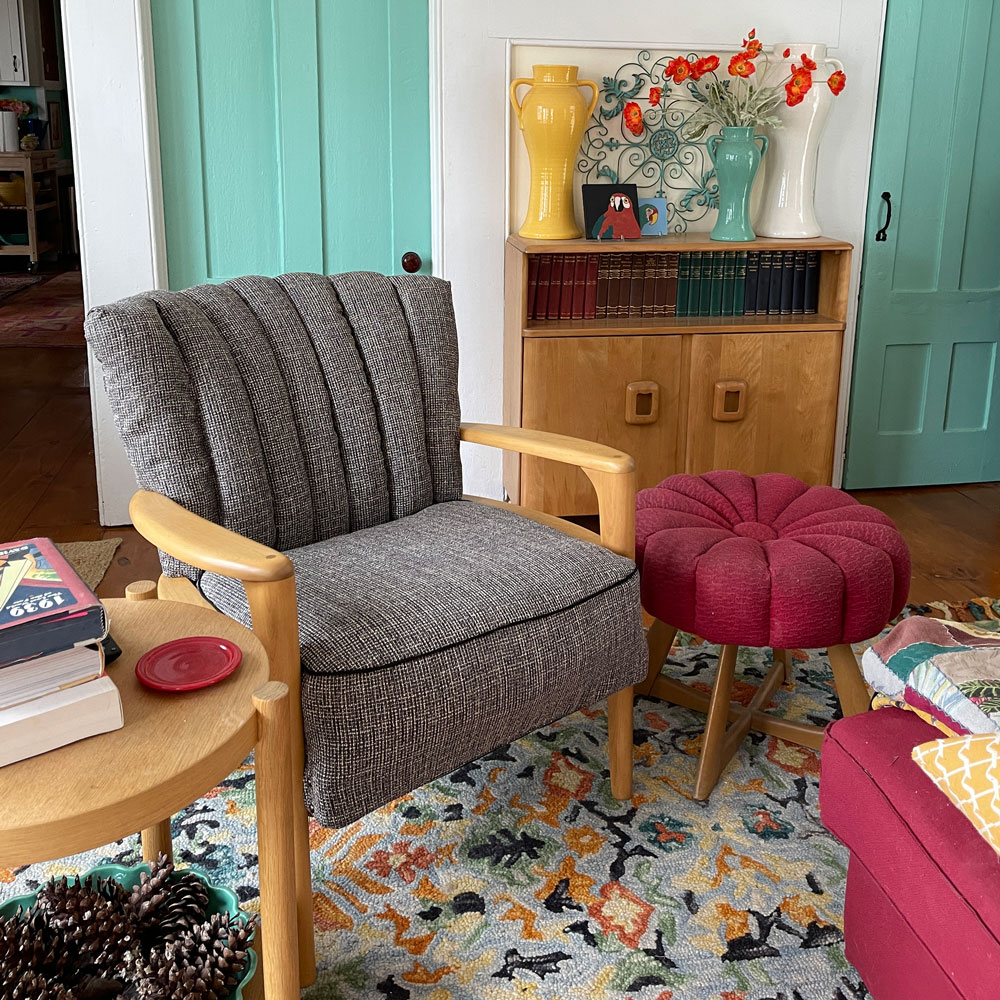
It belongs to the Streamline line, dating roughly to 1941–44, but the exact model does not appear in the catalog material I have found so far. That makes it especially interesting. It has all the visual language of Heywood-Wakefield’s early 1940s upholstered seating: the sculptural wood arms, the flared back, the rounded front legs, and the fan-like channeling across the back cushion. It’s a definite sister of the C3980C Arm Chairs, but with a more solid frame.
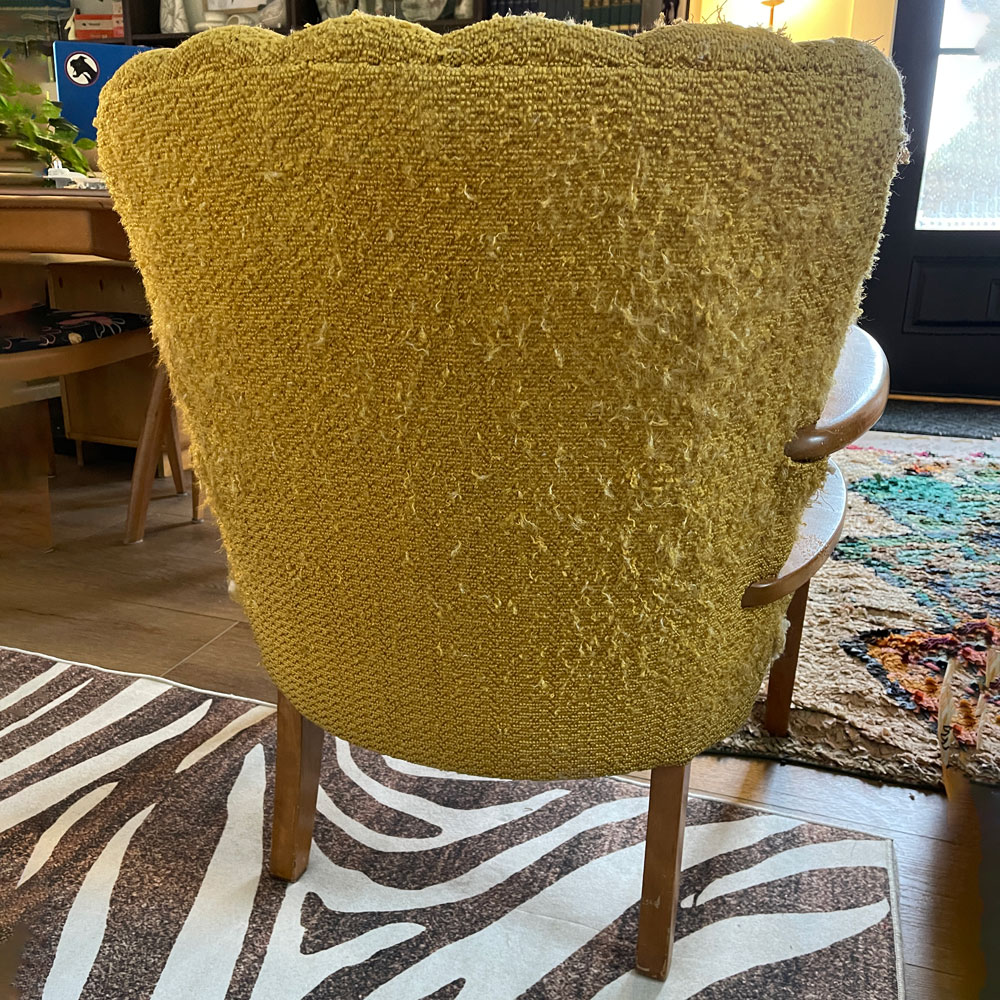
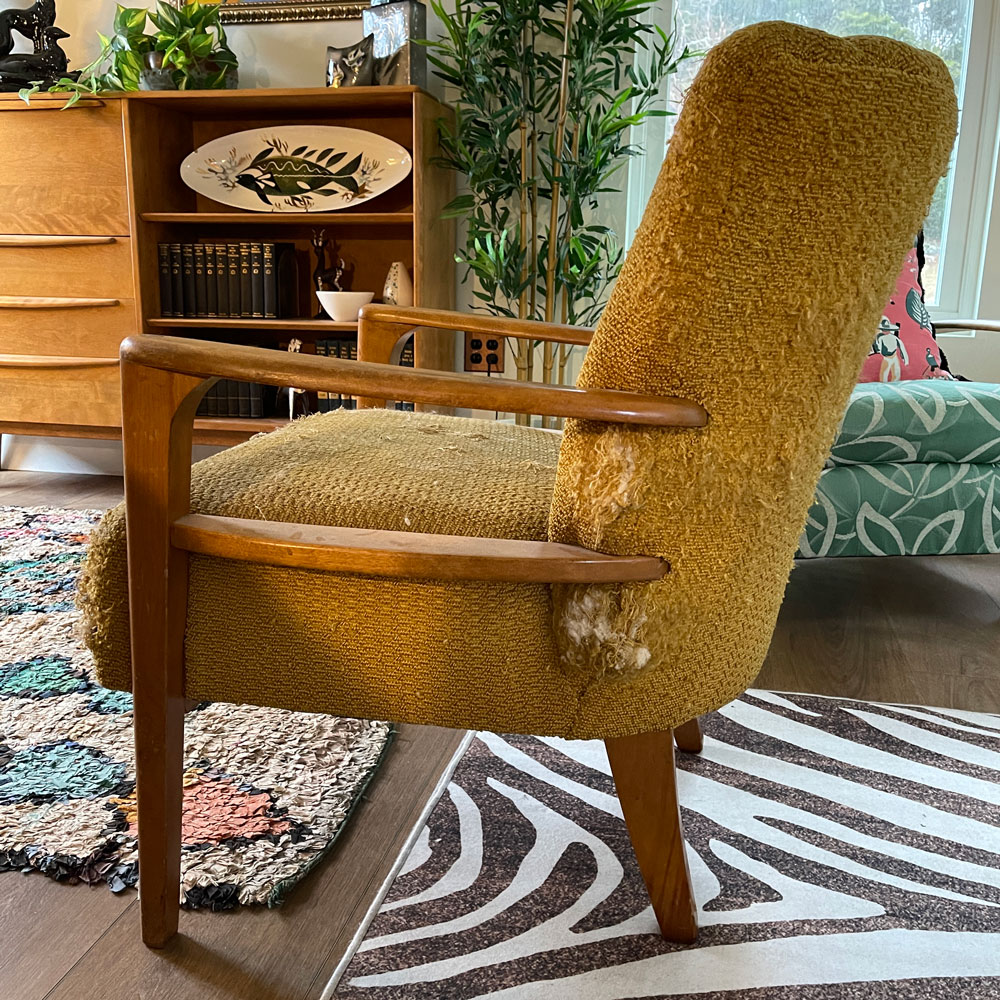
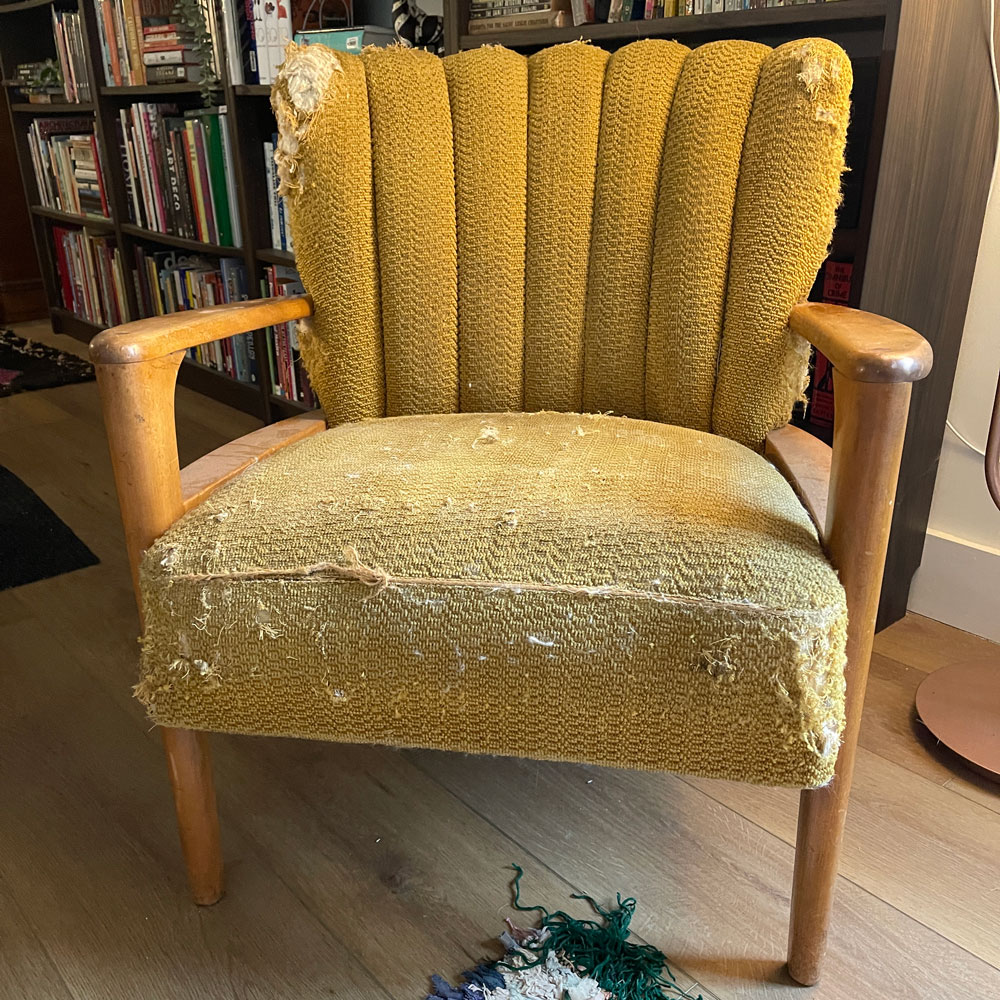
When I bought it, the chair was still wearing its old mustard-gold upholstery, which had clearly lived a full life. The fabric was worn through in multiple places, the edges were frayed, and the stuffing was showing. But underneath the damage, the original upholstery work was completely intact. The channeling on the back, the scalloped top edge, the way the fabric wrapped around the frame, and the relationship between the upholstered shell and the exposed wood arms were all still there.
Upholstered Heywood-Wakefield chairs are much harder to find than the company’s case goods, and examples with their original upholstery still intact are especially uncommon. Fabric simply does not survive the way solid wood does: it wears, stains, fades, gets recovered, or is stripped away entirely, which means that surviving original upholstery can be one of the most useful clues to how these chairs were actually constructed and meant to look.
And unlike tables, dressers, or cabinets, upholstered chairs were often treated as disposable once the fabric failed or the padding broke down. A worn-out chair could look beyond saving even when the wood frame was still sound, so many were likely discarded rather than reupholstered, making intact examples especially valuable as evidence of the original design and construction.
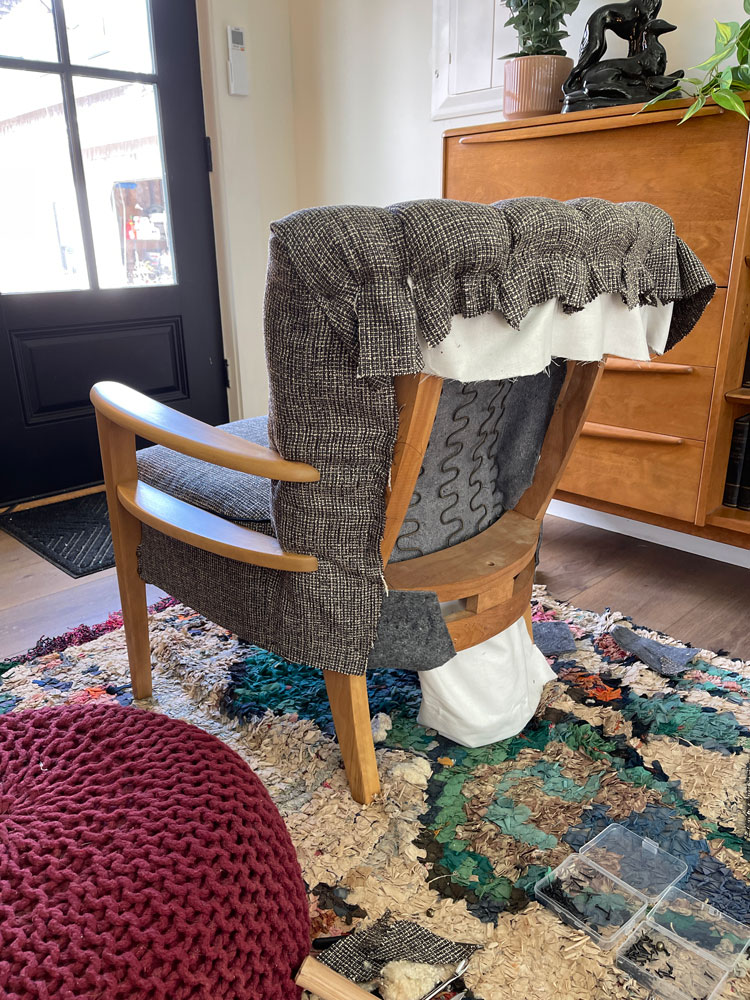
Because this was only the third chair I had upholstered, I approached it slowly. I did not want to “improve” it into something generic. I wanted to understand how it had been made and put it back in a way that respected the original construction. That meant removing the old fabric carefully, studying the layers, photographing the sequence and techniques, and reverse engineering the upholstery rather than simply stripping it down and starting over.
The inside materials were especially important to me. Wherever possible, I kept and reused the original interior structure. The old padding, stuffing, springs, and underlying materials carried the history of how the chair had been built. Modern upholstery often replaces everything with foam and fresh batting, which can make a piece cleaner and more uniform, but it can also flatten the character of the original design. This chair was not meant to feel like a new chair from a showroom. It was meant to remain a 1940s Heywood-Wakefield chair, restored enough to be useful again without losing the evidence of its original making.
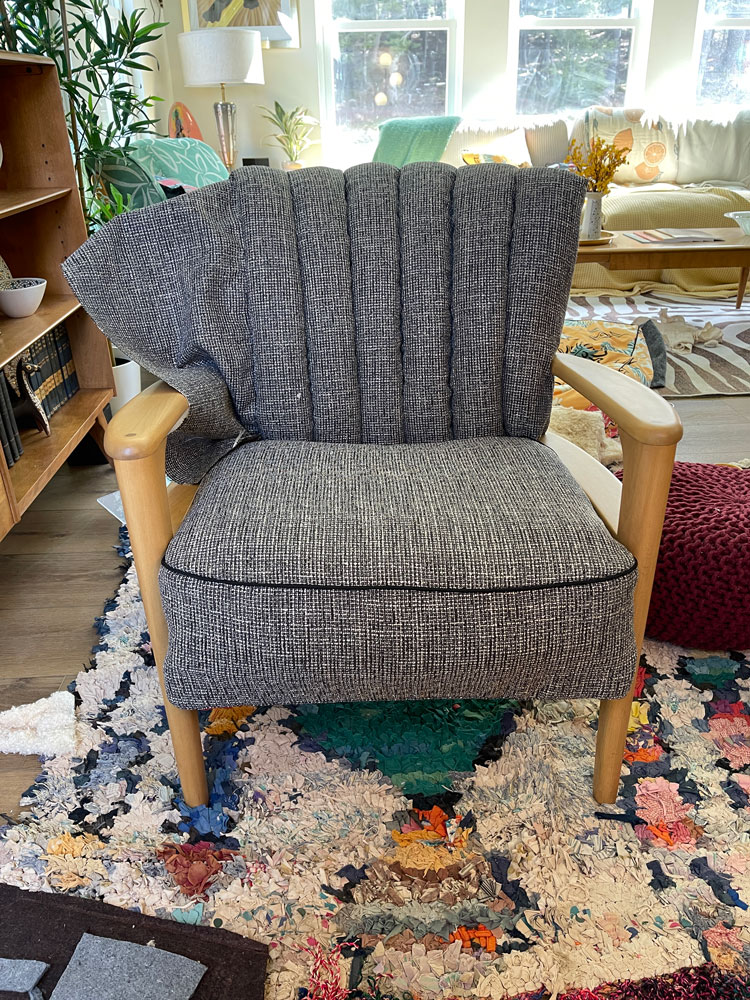
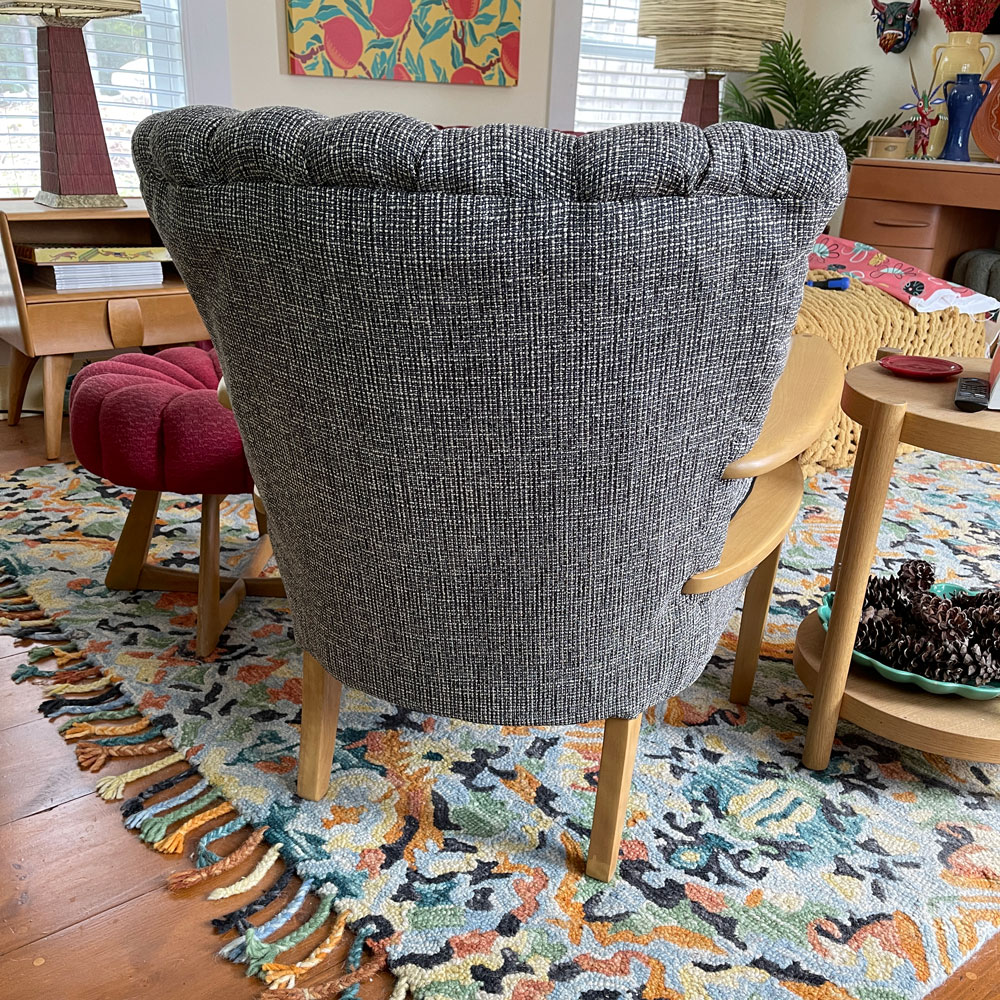
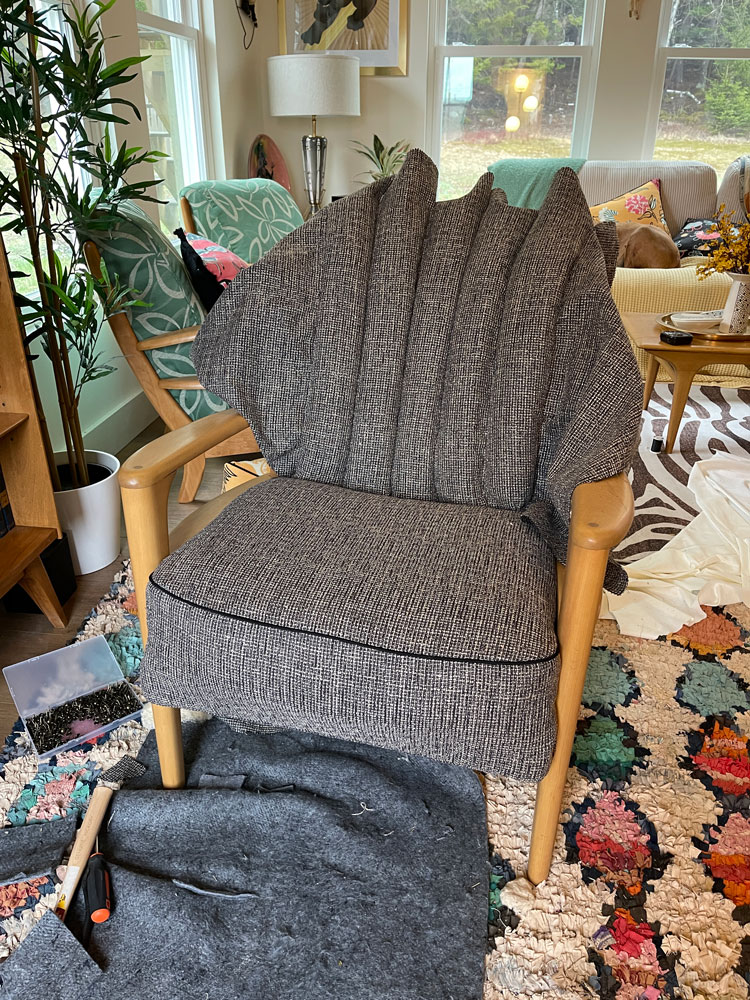
The most challenging part was the back. The chair has a deeply channeled, fan-shaped backrest that looks simple only after it is finished. Each vertical section has to be shaped, padded, pulled, and secured in a way that creates rhythm without becoming stiff or overstuffed. The original upholstery gave me the road map. I could see where the fabric had been drawn into the channels, how the top edge had been softened into rounded lobes, and how the upholstery wrapped around the back to create the chair’s broad, curved silhouette.
For the new fabric, I chose a black, white, and gray woven textile with a small-scale, nubby texture. It is not a literal reproduction fabric, but it feels sympathetic to the period. The scale works well with the frame, and the crosshatched weave gives the chair visual movement without fighting the wood. Against the warm Heywood-Wakefield finish, the fabric creates a good balance: modern, classy, and comfortable.
The wood arms are one of the best parts of the design. They have that unmistakable Heywood-Wakefield quality: rounded, generous, and functional, but still sculptural. From the side, the arms almost draw a continuous line from the back support down toward the front leg. They give the chair a sense of motion, which is exactly what makes the Streamline line so compelling. The shape itself carries the design idea.
Once the new upholstery was on, the chair changed completely, looking less like a rescue project and more like the smart early 1940s piece it always was.
This chair also reminded me that upholstery is a very physical kind of research. You can look at a chair for years and still not understand it the way you do after taking it apart and putting it back together. The process reveals what photographs and catalog pages cannot: how the maker solved problems, where shortcuts were avoided, and how much of the final form depends on what is hidden underneath.
For a third upholstery project, this was probably an ambitious choice. The channels alone were enough to make me question my judgment more than once. But it was worth it. The chair is now usable, structurally intact, and visually alive again. More importantly, it still feels like itself.
That is always the goal with these projects. Not to make the piece perfect. Not to erase its age. Not to turn it into a fantasy version of the past. The goal is to bring it back into use while preserving as much of its original intent as possible.
This Heywood-Wakefield Streamline chair may not yet have a catalog number attached to it, but it now has another chapter. It survived. I survived. It taught me something. And, after a lot of careful reverse engineering, it is back in the room where it belongs.